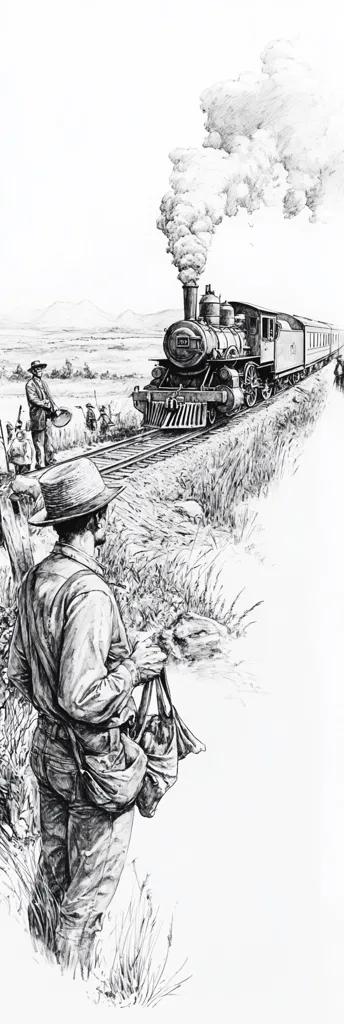
A black and white drawing depicts a steam train chugging across a vast, flat landscape. Smoke billows from its smokestack. In the foreground, a lone figure in a hat and long coat stands in tall grass, seemingly observing the train. Other figures are visible in the distance, suggesting a rural setting. The scene evokes a sense of progress and the impact of the railroad on a sparsely populated region.
isolated in white background A detailed black-and-white pencil sketch depicting the complex legacy of the Canadian Pacific Railway (1885). In the foreground, a Chinese railway worker, wearing traditional worn-out clothing and a straw hat, looks down with a solemn expression, holding a shovel over his shoulder. To his right, a Métis man with a sash stands near railway tracks, watching settlers arrive, symbolizing the displacement of Indigenous communities. Beside him, an Indigenous elder sits on a rock, gazing into the distance, reflecting on the loss of traditional lands. In the middle ground, a steam locomotive travels along newly built tracks, representing Canada’s rapid expansion. Near the train, a government official in a Victorian suit shakes hands with a wealthy businessman, symbolizing the economic and political success of the railway for the Canadian government. To the left, a group of settlers with wagons and supplies move westward, their arrival made possible by the railway, while in the background, an Indigenous family watches from a distance, their expressions filled with sorrow and uncertainty. Further back, a Canadian official posts a sign enforcing the Chinese head tax, representing the discrimination faced by Chinese workers after the railway’s completion. The background features rolling prairies, distant mountains, and telegraph lines, symbolizing progress at a cost. Edges softly fade into the paper, creating an isolated white background, --ar 1:3