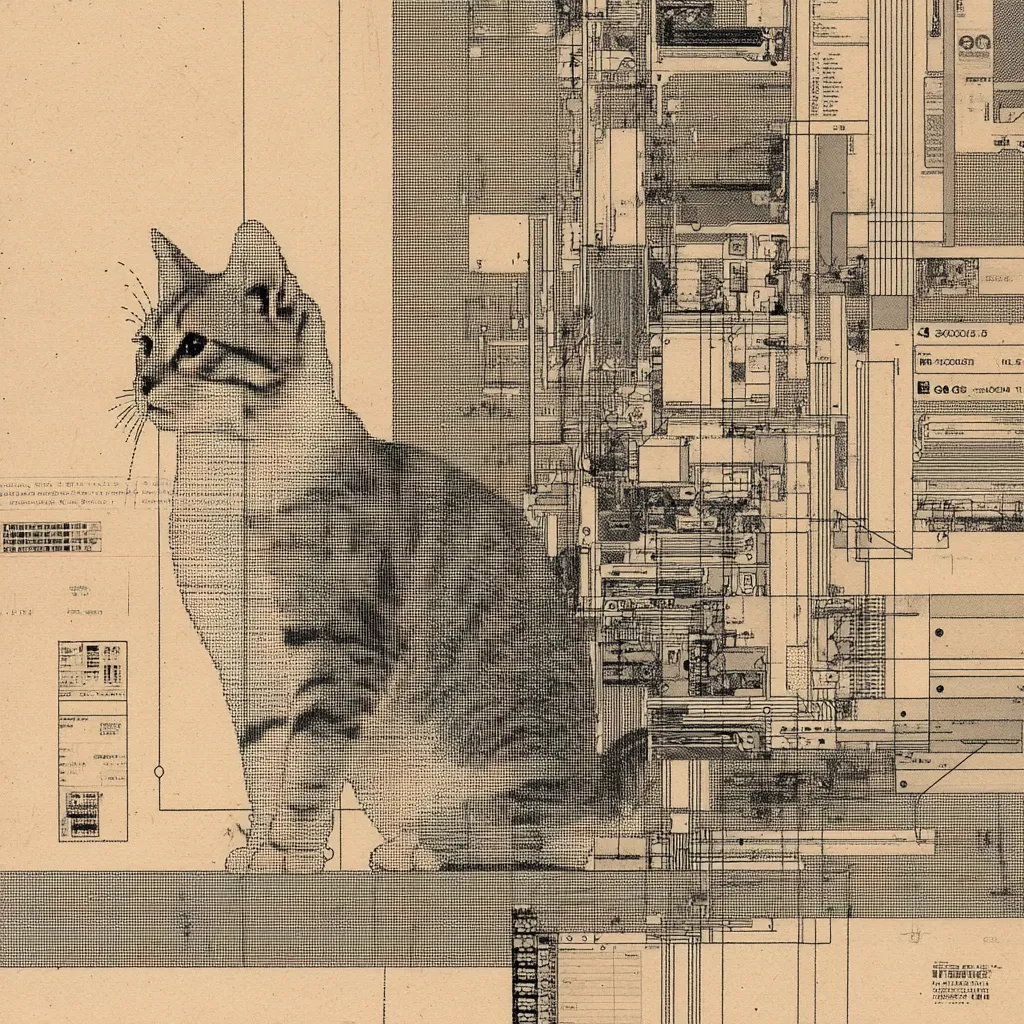
Vintage pointillist cat on technical blueprint, nature and technology.
説明
A sepia-toned image depicts a cat, rendered in a pointillist style, superimposed onto a complex technical blueprint. The cat, appearing calm and seated, contrasts sharply with the intricate network of lines, symbols, and text characteristic of engineering diagrams or circuit schematics. The overall effect creates a juxtaposition between the organic and the technological, evoking themes of artificial intelligence or the merging of nature and technology. The background texture mimics aged parchment paper, enhancing the image's vintage aesthetic.
The piece unfurls as a Bauhaus-era photomontage, a medium that fuses sliced photographs, letterpress type, and abstract geometry into a single, modular surface. Here, the brown tabby is rendered as a halftone fragment--an image built from tiny, evenly spaced dots whose density suggests mid-tone fur--so the animal feels both photographic and schematic. Beneath the tabby, the IBM mainframe dissolves into an exploded axonometric diagram, its backplane separated into orthogonal plates and ribbons, each stamped with crisp sans-serif annotations that recall DIN 1451 engineering stencils. László Moholy-Nagy championed this "typophoto" fusion, insisting that pictures and letters be treated as equally malleable data. In that spirit, every visual element sits on an underlying modular grid--a lattice of invisible columns that imposes Bauhaus functional order--while overlapping transparencies let cables, ferrite-core memories, and feline whiskers interlock like circuits on a logic board. Because photomontage literally means "montage of photos glued together," the work flaunts its seams: deckle-edge tears, offset registration marks, and adhesive halos become part of the composition, reminding the viewer that information is always assembled, never innate. Conceptually the tableau nods to Moholy-Nagy’s Dynamic of the Metropolis (1925) and to Marianne Brandt’s collage postcards, both of which treated industrial modernity as raw material for visual play. The mainframe’s hulking cabinet echoes the tower-like forms in El Lissitzky’s Proun Room, yet its transformation into a diagram evokes Herbert Bayer’s cutaway illustrations for Bauhaus Bücher--didactic images that peeled reality open to reveal underlying systems. By splicing the cat into this lineage, the artist frames feline curiosity as an antecedent to machine cognition: the moment the animal’s paw hovers over a punch-card reader, the montage situates us at the threshold where electromechanical calculation begins its evolutionary drift toward artificial general intelligence. In effect, the tabby mediates between Moholy-Nagy’s mantra "form follows function" and our contemporary suspicion that function may soon exceed its form, inviting viewers who have never seen the work to imagine a playful but uneasy marriage of organic instinct and emergent machine mind. --profile nvhg475 --v 7.0