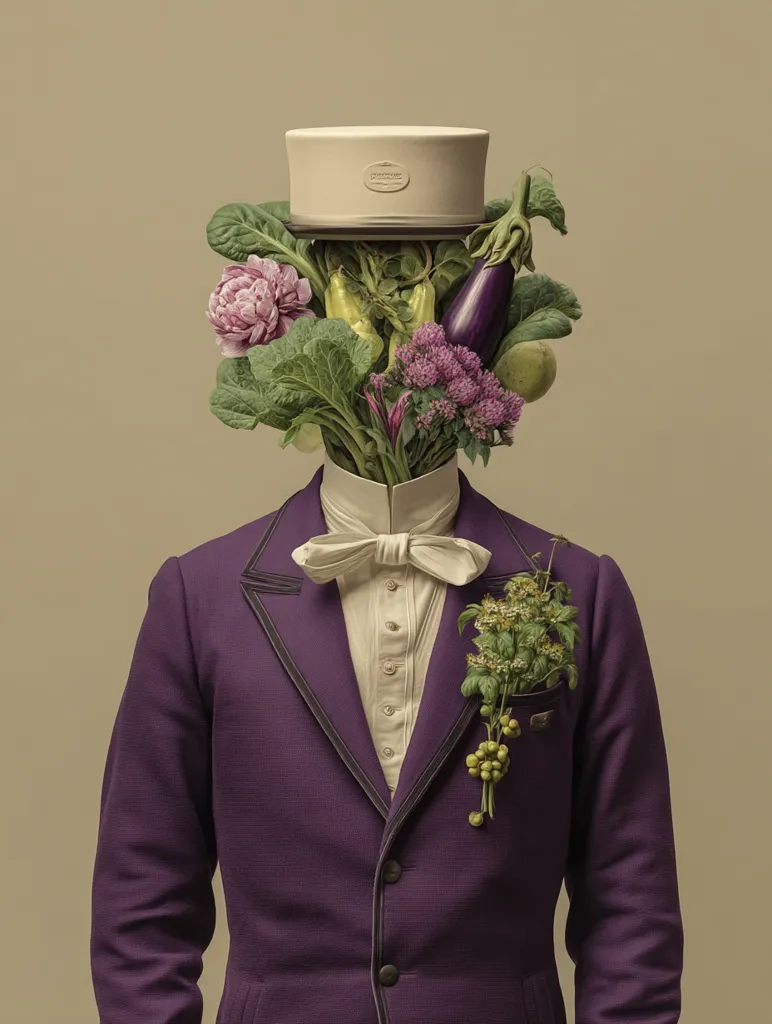
Headless figure in suit, sprouting vegetables and flowers.
描述
A surreal image depicts a headless figure in a purple suit and cream-colored bow tie. Atop the suit is a beige hat, from which various vegetables and flowers sprout: eggplant, leafy greens, a peony, and other blooms. The composition creates a whimsical, almost unsettling, juxtaposition of formal attire and organic growth. The overall effect is artistic and thought-provoking.
This surreal botanical portrait is a whimsical and meticulously composed digital illustration that merges classical portraiture with naturalist fantasy. The subject--a faceless kid whose head has been replaced by a Eggplant--stands at the intersection of Arcimboldo-esque Renaissance absurdity and modern eco-surrealism. Framed in a centrally balanced, symmetrical composition against a plain beige background, the image gains an iconic, poster-like quality, emphasizing the figure’s fruits identity without distraction. The "kid" is elegantly dressed in a rich purple coat, and a white bowtie--a wardrobe that evokes late 19th-century formality, possibly referencing Magritte’s iconic bowler-hatted figures but with a verdant twist. From the cuffs and pockets, various fruits sprout: flowering stems intertwine with his tailored garment as if reclaiming his body. The texture of the jacket is hyper-clean and slightly flattened, typical of vector-based digital rendering, giving it a polished, illustrative feel with no photographic grain or optical distortion--indicative of high-resolution raster or vector software like Adobe Illustrator or Procreate. Botanical accuracy meets imaginative distortion here: each plant species--whether peppers, lilies, or pea pods--is illustrated with scientific precision, recalling the style of 19th-century botanical plates. Yet the surreal narrative--the cabbage-head, the hand emerging from the grass holding playing cards--evokes themes of metamorphosis, disguise, and the symbiosis between man and nature. In his left hand, he holds pince-nez spectacles and a quill, reinforcing his gentleman-scholar persona, while the right hand reveals a magician-like flair, flipping playing cards as if conjuring nature itself. The absence of facial features (replaced by the voluminous green cabbage) is reminiscent of Surrealism, echoing Magritte’s "The Son of Man," but also brings in a quiet ecological critique, suggesting humankind’s fusion--or confusion--with the vegetal world. The aesthetic remains clean and stylized, free of shadows or depth-of-field effects. All elements are equally sharp and saturated, favoring a flat illustrative register rather than photographic realism, allowing for a symbolic and poetic reading. The overall mood is both playful and unsettling--rooted in absurdity, yet executed with scientific grace. The tonal palette is limited but vivid: earthy greens and deep blues dominate, creating a sense of harmony between natural and synthetic. There’s a gentle surrealist elegance in how flora replaces anatomy, while the neutral background lends timelessness and focus, akin to a taxonomic plate or a museum print. This image could sit comfortably in the lineage of contemporary botanical surrealism, echoing the works of Christian Rex van Minnen or Travis Louie, but softened by a naïve elegance closer to children's book illustration or eco-fantasy poster art. It is a work that invites both wonder and quiet reflection on our relationship with the organic world--a poetic mutation at once absurd and strangely dignified. --ar 3:4 --profile 2ob55b5 --v 7.0