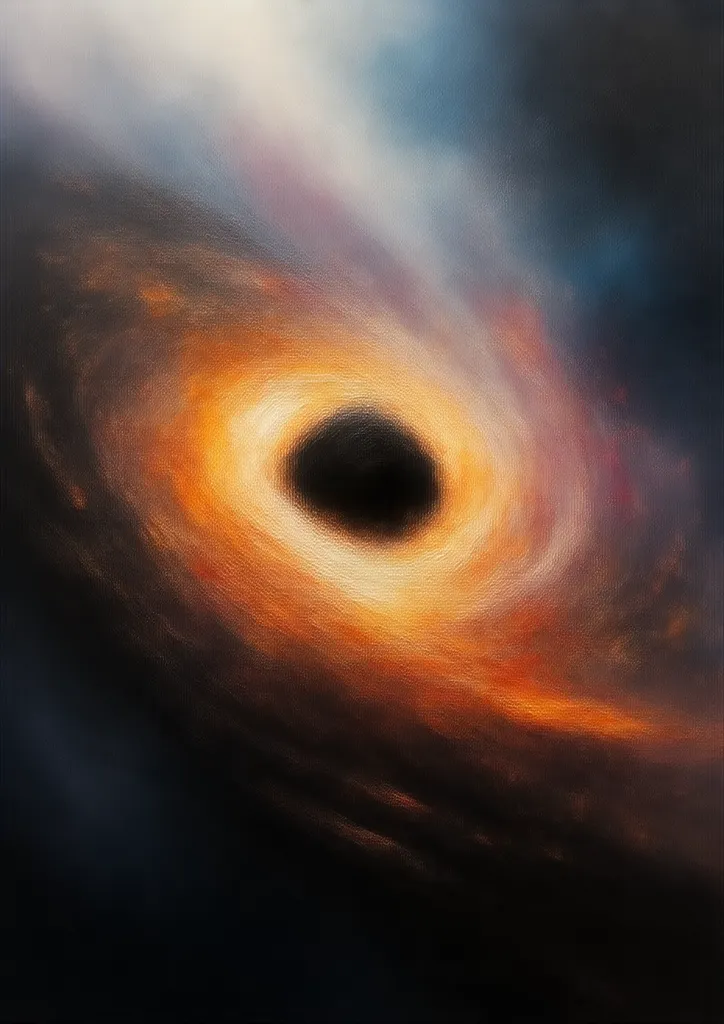
Fiery ring around black hole, dramatic and awe-inspiring space scene.
描述
The image depicts a swirling, fiery orange and yellow ring around a black hole in space. The ring is surrounded by dark, cloudy wisps, creating a sense of depth and mystery. The contrast between the vibrant ring and the dark void adds a dramatic feel to the composition. The painting suggests the immense power and awe-inspiring nature of black holes.
Complete composition, original painting with delicate tones, afterimage, wet on wet oil painting, layered vibrancy, glossy finish, subtle strokes, large canvas paintings, delicate simplicity, Acrylic painting on white linen.Create a painting depicting the moment of a star's collapse into a black hole, observed from a frontal space perspective. This painting should capture the immense energy release and spatial distortion as the star collapses, forming a powerful black hole at its core. Focus on the swirling gravitational forces and the dramatic contrast between light and dark, symbolizing the creation of one of the universe's most enigmatic phenomena. Prepare all necessary materials, including a high-brightness fine linen canvas (preferably black for a more dramatic background), mineral watercolor paints, acrylic paints, watercolor brushes, and syringes for spraying acrylic paint. Begin by using a syringe to spray gradients of deep blue, purple, and black acrylic paint, establishing the background of space. Emphasize the immense darkness of the void while leaving space for the bright, explosive energy bursts. Using the same technique, inject bright orange, yellow, and white acrylics at the center to simulate the dramatic collapse of the star. In Wu Guanzhong’s style, incorporate geometric shapes and bold color blocks to represent the gravitational warping and the formal abstract beauty of the star's collapse. Place the black hole slightly off-center, adding dynamism and suggesting the spiraling pull of gravity. Build the core and energy release: Use geometric abstraction to shape the black hole’s central core, allowing intense light and energy to spiral outwards. Apply thick, swirling strokes to represent the intense gravitational pull. Use Vincent van Gogh’s technique of thick, swirling brushstrokes to amplify the sense of motion, with radiant orange, red, and yellow strokes capturing the last bursts of energy before the black hole fully forms. Add texture to the gravitational field: As you move outward from the core, use Picasso's fragmented style to show matter and light being stretched and absorbed into the black hole. Paint fractured shapes and abstract lines that stretch and distort, simulating the intense warping of space-time around the event horizon. Use mineral watercolors to add delicate texture and finer details, such as subtle color shifts that suggest light bending and gravitational lensing. Emphasize contrast between light and shadow: In the outer regions of the painting, use deep blues, purples, and blacks to represent the vast, empty void of space, while the brightest points should be concentrated near the black hole’s core. Utilize sharp contrasts between the dark background and the bursts of energy to highlight the black hole’s immense gravitational force. Leverage Jackson Pollock's splatter technique to randomly spray bursts of acrylic paint, representing chaotic energy and particles being drawn into the black hole. Explore dynamic color tones: While cool dark tones dominate the outer regions of space, experiment with warm color accents (reds, oranges, and yellows) near the core to represent the intense heat and energy. Incorporate Andre Brasilier’s lyrical style to soften these contrasts, adding a poetic, flowing quality to the energy waves and light distortions around the black hole. Focus on the delicate transition between light and shadow, using watercolors to create soft glows and subtle shifts in color. Capture emotional intensity: Convey the awe-inspiring and fearsome nature of the black hole's creation. This painting should evoke a sense of overwhelming power and inevitable destruction. Use thick acrylic textures to enhance the gravitational pull’s raw force, while finer watercolor strokes should suggest the beauty in the chaos. The painting should communicate the emotional depth of cosmic creation and destruction, reflecting on the delicate balance between life and death, order and chaos in the universe. Once the acrylic background is completely dry, use mineral watercolor paints to add finer details, such as thin lines of light being stretched toward the black hole, and faint, swirling marks that indicate gravitational lensing. These details should be painted with Andre Brasilier’s soft, flowing linework, ensuring that the dramatic energy release is balanced with moments of lyrical subtlety. Position the black hole centrally, or slightly off-center, to emphasize its gravitational dominance within the vast cosmic backdrop. Surround the black hole with transparent layers and circular lines, conveying the bending of light and space-time. These swirling, abstract forms should echo Picasso’s deconstructive approach, giving a fragmented, surreal quality to the scene. Make the black hole’s core starkly defined and dark, a perfect void that stands in sharp contrast to the surrounding energy. This painting should convey both the violence and the beauty of cosmic birth. Use strong contrasts, swirling lines, and thick, textured paint to evoke the immense power of a black hole’s creation. The final piece should be both visually arresting and emotionally profound, offering viewers a window into the heart of one of the universe’s most extraordinary events.Exquisite detail, 30 - megapixel, 4k, 85 - mm - lens, sharp - focus, intricately - detailed, long exposure time, f/ 8, ISO 100, shutter - speed 1/ 125, diffuse - back - lighting, award - winning photograph. --no text, english, words, watermark, signature, copyright, border, blurry, deformed, uninspired, line, signed, seal, calligraphy sea --stop 42 --chaos 10 --ar 5:7 --stylize 1000 --v 6.1