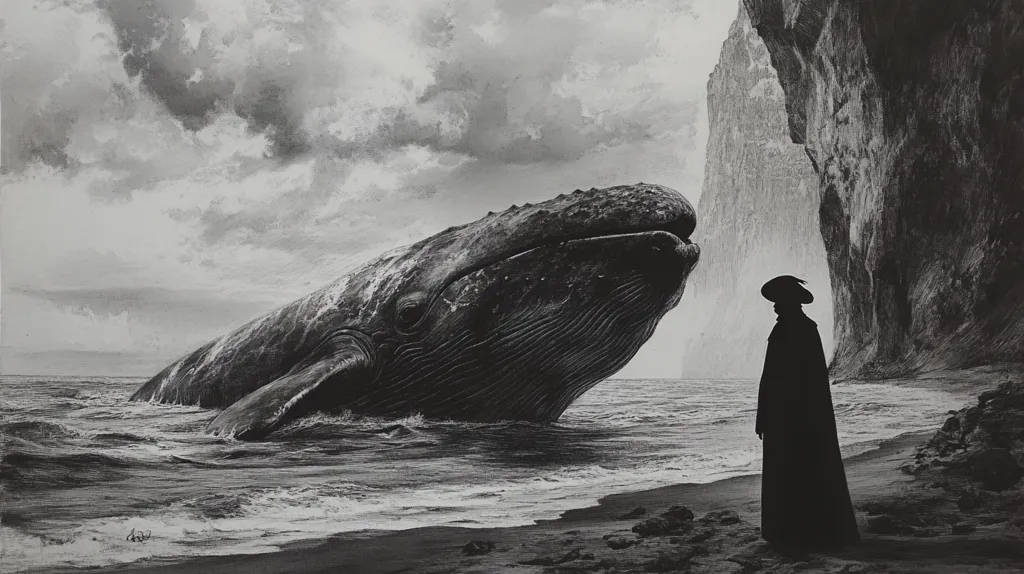
A grayscale illustration depicts a colossal whale emerging from the ocean, its massive form dominating the foreground. A solitary figure, cloaked and hatted, stands on a dark, sandy beach, gazing at the whale. A dramatic, cloudy sky looms above, while rocky cliffs provide a stark backdrop. The scene evokes a sense of awe, mystery, and perhaps even a hint of foreboding, with the immense scale of the whale contrasting with the smallness of the human observer. The overall style is reminiscent of a dark romantic or gothic illustration.
Charcoal on canvas, black and white. A large whale, stranded on the shore. The creature’s immense size dominates the scene, its details rendered with intricate shading to emphasize the texture of its skin and the tragedy of its situation. A solitary figure stands beside the whale. The person is dressed in a long, flowing black cloak that billows slightly in the wind, adding a sense of motion. They wear a tall black hat, reminiscent of a traditional witch hat, casting a shadow over their face, giving them an aura of mystery and melancholy. Rugged Icelandic cliffs rise steeply from the shoreline, their dark, jagged edges contrasting sharply against the lighter tones of the sky and sea. The cliffs are detailed with striations and shadows, emphasizing their ancient, weather-beaten nature. A small expanse of the sea is visible between the cliffs, its surface depicted with gentle, rippling waves. The water’s texture is soft, contrasting with the rough, textured appearance of the cliffs and the whale. The sky is overcast, with heavy clouds rendered in various shades of gray, adding to the somber mood of the scene. The clouds appear dense and oppressive, casting a diffuse light over the landscape. The overall tone of the painting is dark and dramatic, capturing a moment of stillness and sorrow. The black and white palette enhances the starkness and emotional weight of the scene. The use of light and shadow is critical, with deep contrasts highlighting the dramatic cliffs and the stranded whale, while the figure’s cloak and hat blend into the shadows, enhancing their mysterious presence. The painting uses a balanced composition, with the whale and the figure placed centrally to draw the viewer’s focus. The cliffs frame the scene, creating a natural border that guides the eye towards the central subjects. The interplay of light and dark is used to create depth and dimension, giving the scene a three-dimensional quality despite the monochromatic palette. Detailed cross-hatching and shading techniques bring out the textures of the whale’s skin, the rough cliffs, and the billowing cloak. The smooth, subtle gradients in the sea and sky provide a gentle contrast to the more detailed foreground elements. The painting captures a moment of poignant beauty and tragedy, reflecting themes of nature's power and the fragility of life. The solitary figure in black can be interpreted as a guardian, a mourner, or a witness to the event, adding a layer of narrative and emotional depth to the artwork. The stark black and white medium enhances the dramatic, timeless quality of the scene, inviting viewers to reflect on the story behind the image. --ar 16:9 --v 6.1